

It chose 11:47, which was considerate. Lunch had begun; several hundred hot dogs were already committed to a future involving mustard.
Then the future changed.
Vern opened the side panel. Someone found the manual. Someone else suggested turning the machine off and back on, a method humans prefer because it requires neither diagnosis nor apology.
The mustard continued onto the floor.
I watched from a crate and supervised.
Eventually Vern tightened something the manual did not mention, waited, then pressed the start button.
Order returned.
Nobody thanked Vern. Nobody apologized to the mustard.
Standard Provision Hot Dog Company has operated this way for a very long time.
The humans make the hot dogs. The machines move the hot dogs.
I supervise.
My name is Footnote.
Black cat. Amber eyes. Unofficial position.
Nobody appointed me; this has protected the role through several reorganizations.
There was a time when Standard Provision was much larger.
Mortimer's time.
The plant made hundreds of varieties of hot dogs then; enough that nobody seemed entirely certain where variety ended and enthusiasm began. Beef. Pork. Chicken. Cheese-filled. Pepper-studded. Long ones for ballparks. Small ones for schools. Regional recipes. Private labels. Even tofu, which I considered a clerical error. Special runs whose paperwork occasionally outweighed the product.
The smokehouses rarely cooled.
Trucks backed into the loading docks before dawn and left in every direction. Motors stayed warm through winter. Boxes accumulated faster than I could inspect them. Dropped ends appeared behind Packaging with sufficient regularity to support a schedule.
It was a good place to be a cat.
By most accounts, it was also a good place to work.
Standard Provision was busy, slightly chaotic and confident in the way successful places often are before they begin documenting everything that made them successful.
Mortimer understood that.
He was refined in a place that had little practical need for refinement. Polished shoes. Pressed trousers. Measured voice. He could stand in the middle of a production problem looking as though he had arrived slightly early for dinner.
He was not management, though management frequently discovered it agreed with him.
He was not a mechanic, though mechanics listened when he asked about a machine.
He was not a philosopher in any official capacity; this probably preserved his usefulness.
Mortimer asked questions.
Quiet ones.
Precise ones.
The sort that made a room slower.
He rarely told anyone they were wrong. He simply asked one more question until they had the opportunity to notice it themselves.
I followed him as a kitten. From floor level, I knew him mostly by his steady stride and the fact that it kept moving while other people were still discussing the problem. He called me Footnote because I trailed the main text.
The joke stayed.
So did the education.
"Never do anything once you don't want to be doing for the rest of your life."
Mortimer said that.
He understood how quickly a favor becomes a process.
Mortimer's not here anymore.
The plant he knew is smaller now. Fewer trucks leave the loading dock; fewer varieties come off the line. Some machines disappeared. Some jobs did too.
The paperwork proved more difficult to remove.
Standard Provision carried on.
That is one of the things I admire about the place.
It is also one of the things that worries me.
Mortimer taught me that a good system remembers what matters. He was less enthusiastic about systems that remembered everything.
There is a yellow line across the factory floor.
Nobody knows why.
It has been there long enough that people no longer see a yellow line. They see the place where you walk around.
So they walk around it.
Every shift. Every day.
I don't.
This is not rebellion. It is geometry.
The shortest distance between where I am and where I intend to be has never improved because somebody painted the floor.
For years, this arrangement caused no difficulty.
Then Selden showed up.
Fresh out of high school. No office. No title. No carefully worded biography explaining what he intended to become.
Standard Provision gave him the work nobody else requested.
Wet floors. Heavy boxes. Clogged drains. Things underneath machines.
This turned out to be an education.
Selden paid attention to people who knew how to do things. He listened when Vern named a part. He noticed when Sol took a different route through the plant. He asked questions before he learned which questions everyone else had agreed to stop asking.
He also noticed me.
That put him ahead of several managers.
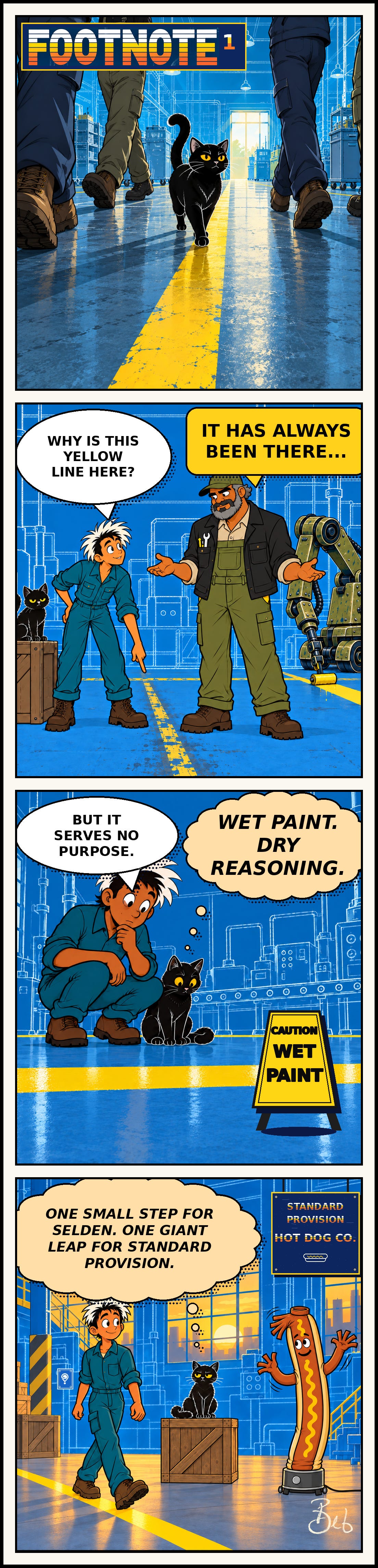
The first time Selden saw a line of workers detour around the yellow stripe, he watched them.
Then he saw me walk straight across it.
He stopped.
So did I, although I had the courtesy not to make it obvious.
Selden pointed at the floor.
"Why is this yellow line here?"
Vern was nearby.
Vern knows the proper name of every machine part, including several the manufacturer appears to have forgotten. He looked at the line; then at Selden.
"It has always been there..."
That was the answer.
Not a history.
Not an explanation.
An answer.
Behind them, Ernest was repainting it.
Ernest is an old olive robot arm on wheels. He does not ask why a work order exists; he receives it and performs the work.
The line had faded.
The work order said repaint.
Ernest repainted.
Fresh yellow rolled over old yellow while Vern explained that the yellow had always been yellow.
I watched from my crate.
Then I looked out.
There are moments when commentary only weakens the evidence.
Ernest finished.
The line looked excellent.
A bright yellow sign appeared beside it.
CAUTION WET PAINT.
This was thoughtful.
Selden crouched beside me, chin resting on one hand.
"But it serves no purpose."
Correct.
I said nothing.
Humans do not hear me; this has prevented many unnecessary conversations.
I considered the fresh paint, the caution sign protecting it, and the people carefully walking around both.
Wet paint. Dry reasoning.
Nobody had failed.
Ernest had followed the work order. Vern had supplied the accepted answer. The line had been maintained to specification.
The system was functioning normally.
Selden stood.
Then he stepped onto the line.
Not over it.
Onto it.
He put one foot directly on the fresh yellow stripe and began walking along it.
Slowly.
Relaxed.
No announcement. No glance around to see who had noticed. Nothing to prove.
He simply walked.
The way I had been doing for years.
This was better.
Stepping across a line can be defiance; walking on it means the line has stopped telling you where to go.
I approved.
I also knew what questions cost.
Mortimer had taught me that too.
Ask why once and you are curious.
Ask twice and you are thorough.
Continue long enough and somebody begins describing your attitude.
Selden did not know this yet.
I did.
That did not make the question less valuable; it merely made it expensive.
I had adopted him.
He did not know that either.
My methods are subtle.
Mostly I walk across things.
Outside stood Frank.
Frank is part of the team.
Most people think Frank is an inflatable hot dog used to attract attention from the road. This is technically accurate in the way that calling a thermometer a glass tube is technically accurate.
Frank is the plant's morale report.
He never speaks; he does not need to.
On good days he stands tall and waves with improbable stamina. On bad days he folds at the waist and stares toward the parking lot.
Management calls this air pressure.
Management has access to many explanations.
I know Frank.
I know when the floor is tired before anyone schedules a survey to determine whether the floor is tired. I know when a memo has landed badly because Frank has already lost six inches of conviction.
His posture is the only report in the building nobody has edited.
I vouch for him.
That afternoon, Frank was upright.
More than upright.
He waved with something I had not seen from him in a while.
Hope.
Not much.
Frank is sensible.
But enough.
The yellow line remained.
Of course it remained.
Systems are durable; that is why people build them.
Habits are more durable; nobody remembers building those.
Ernest may paint the line again. Someone may issue another work order. Home Office may eventually discover the matter and circulate an explanation of why the line is essential.
Standard Provision knows how to survive.
Once, it knew how to thrive.
I remember the trucks. The smokehouses. Hundreds of varieties moving out into the world. Mortimer walking the floor, asking the question after the question everyone else considered sufficient.
Perhaps places do not lose that entirely.
Perhaps they bury it under procedure, repaint it once a year, and walk around it until somebody new arrives who has not yet learned where he is supposed to step.
Selden noticed.
He asked why.
He heard the answer.
He decided the answer was not enough.
Then he walked on the line.
One small step for Selden. One giant leap for Standard Provision.
What might this place become again if more people asked why‽

Brad E. Bailey · brad@theinterrobang.net · SimpleX Chat
© 2026 Brad E. Bailey. The Interrobang™ and FOOTNOTE™ are trademarks of Brad E. Bailey.