

I was about 15 when my Aunt Jean asked if I wanted my great-grandfather’s sewing machine.
My father and I drove up from Maryland to Philadelphia to get it. I don’t remember much about the drive, which is probably evidence that my father was driving and I was 15.
I remember the basement.
Down a narrow flight of wooden stairs in an old Philadelphia row house, beneath a small window that let in just enough gray light to establish that there was, in fact, a basement, sat Giovanni DiGiuseppe’s Singer.
The stairs creaked the whole way down.
It felt like something out of The Goonies. My own treasure hunt, and at 15 I was certain I’d found the treasure.
I was so excited to get my hands on a piece of my family’s history.
I had no idea how much history was riding on it.
It looked ancient.
Black cast iron. Dark wood. Little drawers. Worn gold lettering. A broad foot treadle underneath.
No electricity required.
It had been sitting there for years. Not displayed. Not preserved behind velvet rope. Just waiting beneath the window among the ordinary accumulation of a family basement.
And heavy.
It should have taken three people. It took my dad and me an hour, and we made it work.
I don’t have a picture of that day in the basement, but I remember it well. Lots of things in that room must have made perfect sense to my great-grandfather and were completely foreign to me.
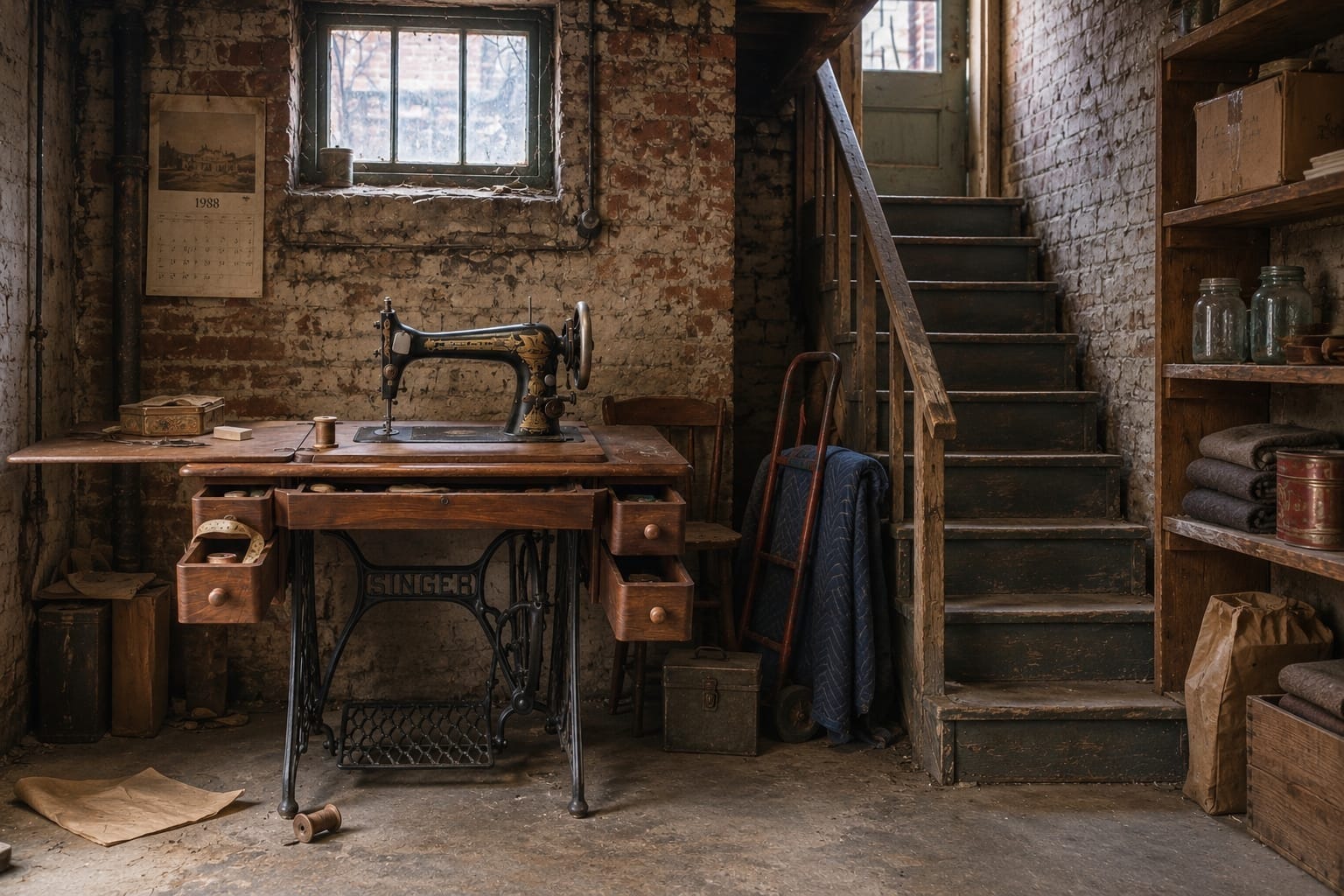
I recently recreated that basement scene from memory. Ahh, the miracle of AI.
The Singer itself came from the early 1900s. My great-grandfather Giovanni came from Abruzzo, Italy, settled in South Philadelphia, and made his living as a tailor.
Think about that machine for a moment.
That Singer helped put five children through college.
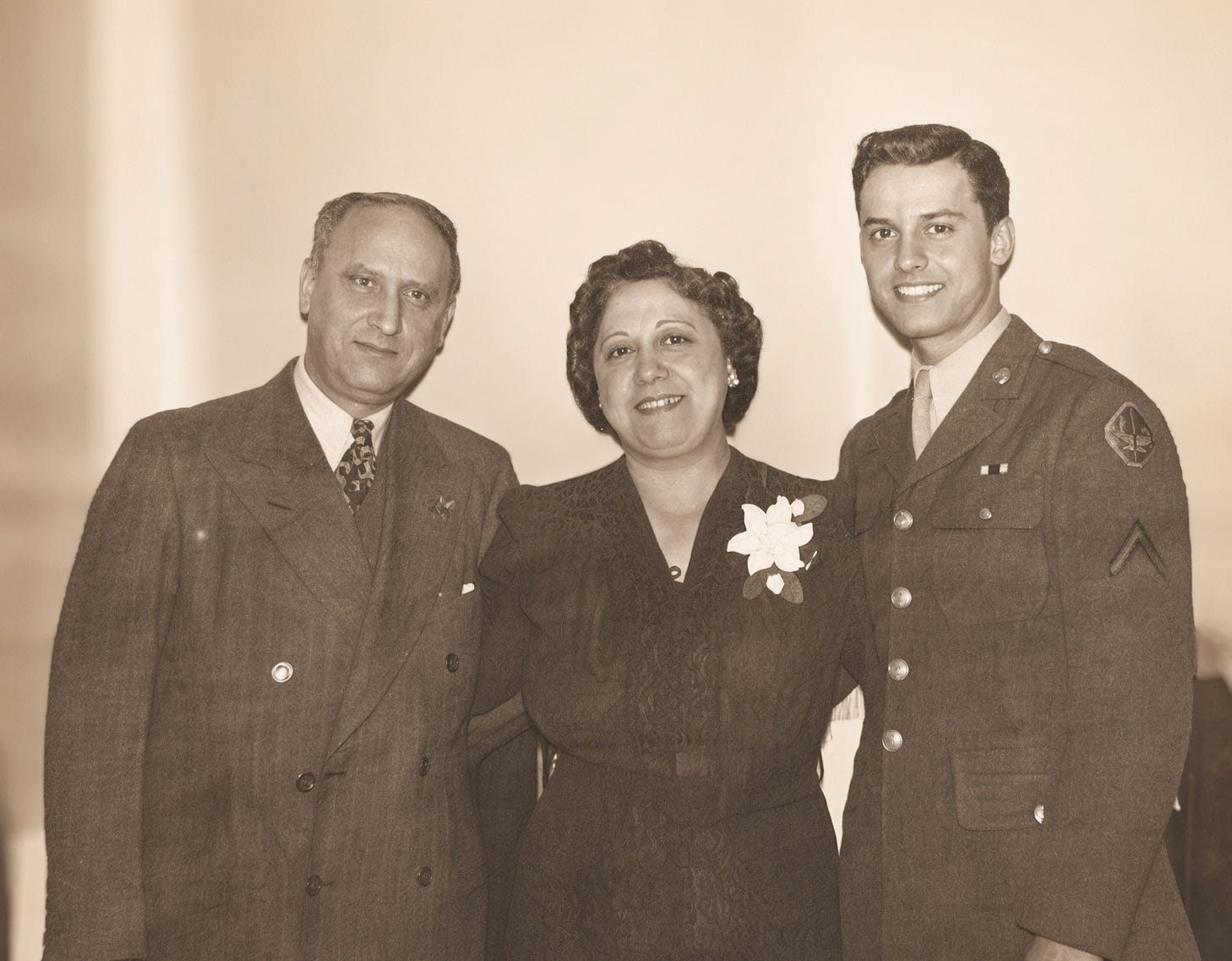
One was my grandfather Benjamin, who went on to graduate from dental school.
He’s the good-looking one in the photograph.
I feel reasonably confident saying that.
Giovanni’s tools were not terribly impressive.
Chalk. Pins. Measuring tape. Shears. An iron. Thread.
And that Singer.
But mostly, his hands.
A tailor touches the cloth before he cuts it.
He rolls it between his fingers. Lifts it. Lets it fall. Pulls gently against the weave.
Wool has weight. Linen wanders.
Silk requires diplomacy.
Knowing the name on the bolt isn’t enough. The material in front of you has its own behavior, and you would be wise to learn something about it before introducing it to the shears.
Then comes the customer.
A good tailor doesn’t measure the person described in the pattern book.
He measures the person standing in front of him.
Tape around the chest. Across the shoulders. Down the arm.
Again.
One shoulder may sit slightly lower. An arm may hang differently. A waist may occupy more territory than its owner remembers from the last fitting.
The tape remains diplomatically neutral.
Then comes the chalk.
Draw a line.
Look at it.
Move it.
Draw another.
Chalk is cheap. It is also wonderfully forgiving. A chalk line is an idea. You can reconsider it without ruining anything.
The shears are different.
Shhhk.
Once steel passes through cloth, the conversation changes.
There is less room for theory.
Measure twice, cut once.
This is why it has survived so long. It isn’t particularly clever. It doesn’t have an acronym. Nobody needed to write a management book about it.
It just works.
Much of good work still happens this way. Understand what is actually in front of you. Make the inexpensive corrections while corrections are still inexpensive. Be deliberate when the next move cannot easily be undone.
Then make the cut.
After that came the fitting.
If the jacket pulled across the shoulder, Giovanni didn’t throw it away and start shopping for a more innovative jacket.
He worked it.
Pin it. Open the seam. Let it out. Take it in. Press it.
Try again.
There was patience in that.
C.S. Lewis had a name for one of our stranger modern habits: chronological snobbery, the tendency to assume that an idea is inferior simply because it belongs to an earlier time.
We are remarkably good at it.
New becomes better. Old becomes obsolete.
At work, this can take a particularly entertaining form. A perfectly useful practice falls out of favor, returns a few years later with a new name, a diagram and perhaps a consultant attached to it.
We announce the innovation.
Giovanni would have regarded it as Tuesday.
Sometimes the old thing was discarded for good reason. Better tools appear. Better methods are discovered. Progress is real, and I am quite fond of indoor plumbing.
But newness itself proves remarkably little.
We replace things that could have been repaired. We abandon methods that required patience because something faster has arrived. We occasionally confuse efficiency with improvement.
The tailor understood a distinction we sometimes forget.
Something can need adjustment without needing replacement.
We built an economy on the opposite instinct.
A phone is obsolete in three years. A jacket is cheaper to replace than to hem.
Somewhere along the way, ‘fix it’ became a sign you couldn’t afford a new one.
Giovanni’s customers brought back the same coat for twenty years, and each time he found something left to work with.
That old Singer is part of the lesson for me.
It was not sophisticated by today’s standards. It didn’t anticipate what Giovanni wanted. It didn’t correct him. It didn’t make him a tailor.
It did one thing remarkably well.
It stitched.
The judgment belonged to the man sitting behind it.
The hands touching the wool were his. The eye catching the uneven shoulder was his. The chalk line was his. The decision to move that line before cutting was his.
The machine was a tool.
A very good one.
We restored Giovanni’s Singer after bringing it home.
I have it now.
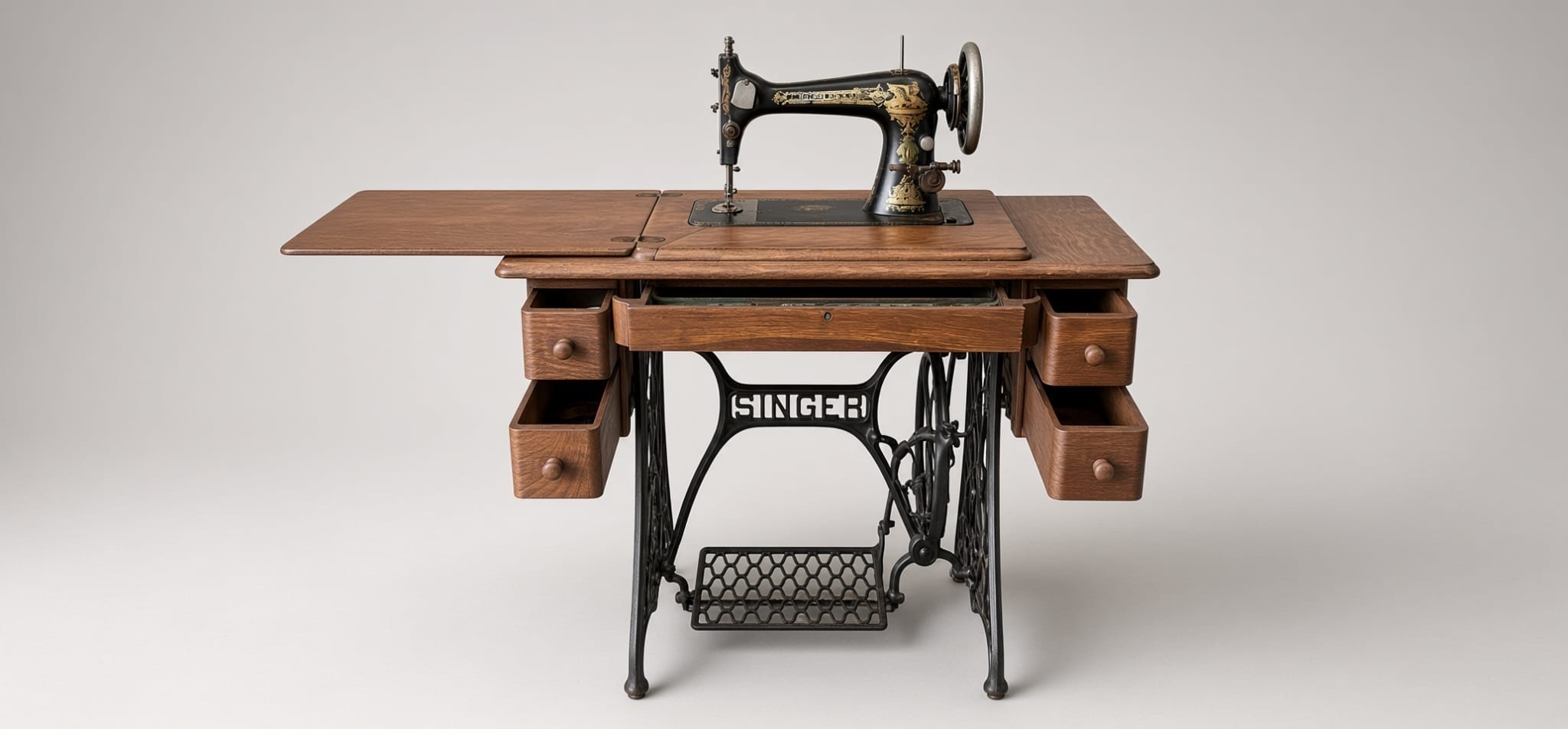
More than a century after it was made, it is still absurdly heavy. Still beautiful. Still unmistakably old.
And it still works.
I like that more as I get older.
Think about the decision behind that machine.
At some point, in South Philadelphia, a tailor decided he needed a Singer. He bought it used. It probably cost more than was comfortable that year.
That one decision put five children through college. One became a dentist. His children followed, then cousins, then their children, and so on.
Nobody making that purchase was thinking about me.
I was a military brat. My places were only places.
I’m not from Maryland, or anywhere else on a map. I’m from a series of decisions.
Some were my family’s. Some were mine.
We are all past decisions, showing up today.
Every decision we make is a decision for someone we haven’t met.
That’s the part worth measuring twice.
The tool changes. The craft shouldn’t.
‽
What decision are you making this year that someone you’ll never meet will inherit?

Brad E. Bailey · brad@theinterrobang.net · SimpleX Chat
© 2026 Brad E. Bailey. The Interrobang™ and FOOTNOTE™ are trademarks of Brad E. Bailey.